Hardhat Vs Foundry Vs Anchor Vs Truffle Vs Remix: Complete 2026 Web3 Development Frameworks Guide
Choosing the right development framework is one of the most critical decisions for Web3 developers in 2026. With billions of dollars in smart contract value and increasingly complex decentralized applications, the tools you use can make or break your project.
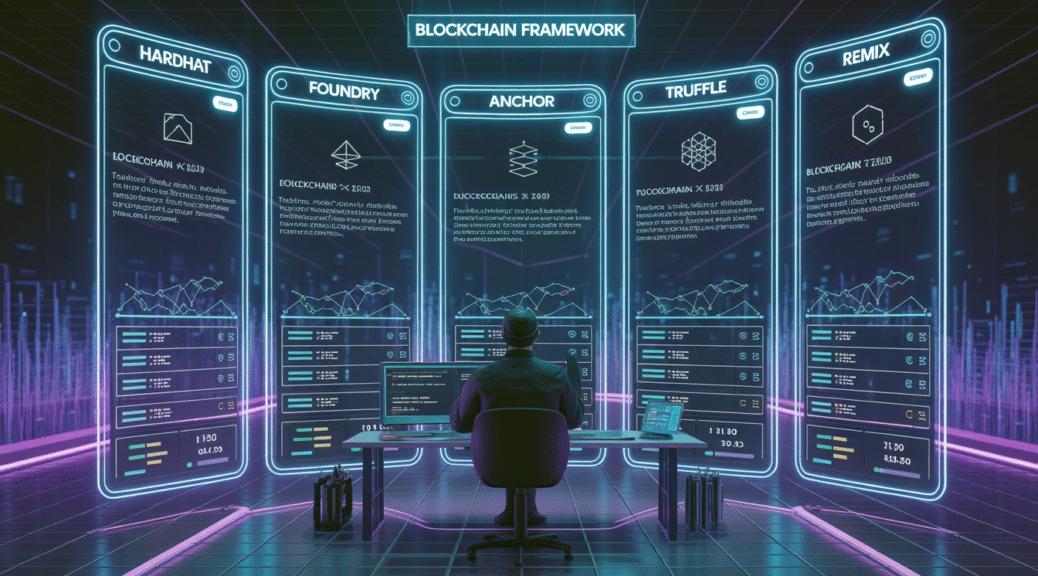
This comprehensive guide compares the five major Web3 development frameworks: Hardhat (Ethereum), Foundry (Ethereum), Anchor (Solana), Truffle (Ethereum legacy), and Remix (browser-based IDE). We’ll examine their strengths, weaknesses, and ideal use cases to help you decide which framework wins in 2026.
Overview of Web3 Development Frameworks
Hardhat: The JavaScript Veteran
Primary Use: Ethereum and EVM-compatible chains
Language: JavaScript/TypeScript
Launch: 2019
2026 Status: Mature, widely adopted
Market Share: ~60% of Ethereum projects
Hardhat has been the go-to framework for Ethereum developers since its inception. Built on Node.js, it offers a familiar environment for JavaScript developers transitioning to Web3.
Foundry: The Rust Revolution
Primary Use: Ethereum and EVM-compatible chains
Language: Rust/Solidity
Launch: 2021
2026 Status: Rapidly growing, performance-focused
Market Share: ~30% of Ethereum projects (growing 300% YoY)
Foundry represents a paradigm shift in Ethereum development. Written in Rust, it offers native Solidity testing and unprecedented performance.
Anchor: The Solana Specialist
Primary Use: Solana
Language: Rust
Launch: 2021
2026 Status: Solana standard, rapidly evolving
Market Share: ~90% of Solana projects
Anchor is the de facto framework for Solana development, providing essential abstractions and safety features for the unique Solana programming model.
Truffle: The Legacy Pioneer
Primary Use: Ethereum and EVM-compatible chains
Language: JavaScript
Launch: 2015
2026 Status: Legacy, declining adoption
Market Share: ~5% of Ethereum projects (down from 80% in 2020)
Truffle was the first major Ethereum development framework, pioneering many concepts still used today. While still maintained, it has largely been superseded by newer tools.
Remix: The Browser IDE
Primary Use: Ethereum and EVM-compatible chains
Language: Browser-based (JavaScript)
Launch: 2016
2026 Status: Essential learning tool, rapid prototyping
Market Share: ~80% of developers use it for learning/prototyping
Remix is a browser-based IDE that requires no installation, making it perfect for beginners, quick prototypes, and educational purposes.
Detailed Comparison
Performance Benchmarks (2026)
| Metric | Hardhat | Foundry | Anchor | Truffle | Remix |
|---|---|---|---|---|---|
| Test Execution Speed | 1x (baseline) | 10-50x faster | 3-5x faster | 0.5x (slower) | N/A (browser) |
| Compilation Time | Moderate | Fastest | Fast | Slow | Fast (cloud) |
| Memory Usage | High (Node.js) | Low (Rust) | Moderate | High | Browser-based |
| Startup Time | 2-5 seconds | <1 second | 1-2 seconds | 5-10 seconds | Instant (web) |
| Deployment Speed | Fast | Fastest | Fast | Slow | Moderate |
Developer Experience
Hardhat
- Pros: Extensive plugin ecosystem, excellent documentation, familiar JavaScript environment, TypeScript native
- Cons: Slower tests, higher memory usage, JavaScript limitations
- Learning Curve: Gentle for JavaScript developers
- Best For: Teams with JavaScript expertise, enterprise projects
Foundry
- Pros: Blazing fast, native Solidity testing, excellent fuzzing, invariant testing, gas optimization
- Cons: Smaller ecosystem, steeper learning curve, limited TypeScript support
- Learning Curve: Moderate to steep
- Best For: Performance-critical applications, security-focused projects
Anchor
- Pros: Solana-specific optimizations, safety guarantees, IDL generation, Rust performance
- Cons: Solana-only, requires understanding Solana architecture, smaller ecosystem
- Learning Curve: Steep (Rust + Solana concepts)
- Best For: Solana development exclusively
Truffle
- Pros: Historical significance, extensive tutorials, Ganache integration
- Cons: Slow performance, outdated architecture, declining maintenance
- Learning Curve: Moderate (but outdated patterns)
- Best For: Maintaining legacy projects, educational historical context
Remix
- Pros: No installation required, instant start, great for learning, built-in debugger
- Cons: Limited project management, browser limitations, not for production
- Learning Curve: Easiest (beginner-friendly)
- Best For: Learning, quick prototypes, testing ideas
Feature Comparison
Testing Capabilities
| Feature | Hardhat | Foundry | Anchor | Truffle | Remix |
|---|---|---|---|---|---|
| Unit Testing | ✅ Excellent | ✅ Excellent | ✅ Good | ✅ Good | ⚠️ Basic |
| Integration Testing | ✅ Excellent | ✅ Excellent | ✅ Good | ✅ Good | ❌ Limited |
| Fuzz Testing | ⚠️ Limited | ✅ Best-in-class | ⚠️ Basic | ❌ No | ❌ No |
| Invariant Testing | ❌ No | ✅ Excellent | ❌ No | ❌ No | ❌ No |
| Gas Reporting | ✅ Good | ✅ Excellent | ✅ Good | ⚠️ Basic | ✅ Good |
| Debugging | ✅ Excellent | ✅ Good | ✅ Good | ✅ Good | ✅ Excellent |
Deployment & Tooling
| Feature | Hardhat | Foundry | Anchor | Truffle | Remix |
|---|---|---|---|---|---|
| Multi-chain Deployment | ✅ Excellent | ✅ Good | ❌ Solana only | ✅ Good | ⚠️ Limited |
| Plugin Ecosystem | ✅ Extensive | ⚠️ Growing | ⚠️ Limited | ✅ Good | ❌ Minimal |
| CI/CD Integration | ✅ Excellent | ✅ Good | ✅ Good | ✅ Good | ❌ No |
| TypeScript Support | ✅ Native | ⚠️ Limited | ⚠️ Limited | ⚠️ Limited | ❌ No |
| Production Ready | ✅ Yes | ✅ Yes | ✅ Yes | ✅ Yes | ❌ No |
| Learning Resources | ✅ Abundant | ✅ Growing | ✅ Good | ✅ Extensive | ✅ Excellent |
Extensive Use Cases
Hardhat Use Cases
1. Enterprise DeFi Protocols
Example: Building a complex lending protocol like Aave or Compound
- Why Hardhat: Extensive plugin ecosystem for oracle integration, security tools, and monitoring
- Key Features Needed: Multi-chain deployment, extensive testing, plugin integration
- Team Profile: Large JavaScript/TypeScript team with established DevOps
2. DAO Governance Systems
Example: Creating a sophisticated DAO like MakerDAO or Uniswap
- Why Hardhat: Excellent for complex integration testing with frontend frameworks
- Key Features Needed: Integration with React/Vue.js, snapshot testing, gas optimization
- Team Profile: Full-stack developers familiar with JavaScript ecosystem
3. Enterprise Blockchain Solutions
Example: Supply chain tracking or enterprise tokenization
- Why Hardhat: Mature, stable, enterprise-friendly with extensive documentation
- Key Features Needed: Audit trail, compliance features, enterprise integration
- Team Profile: Corporate development teams with strict requirements
Foundry Use Cases
1. High-Frequency Trading DEX
Example: Building a DEX aggregator like 1inch or Matcha
- Why Foundry: 10-50x faster tests enable rapid iteration on trading logic
- Key Features Needed: Fuzz testing for edge cases, gas optimization, performance
- Team Profile: Performance-focused team with Rust/Solidity expertise
2. Security-Critical DeFi Protocols
Example: Creating a new lending protocol or yield optimizer
- Why Foundry: Best-in-class fuzzing and invariant testing for security
- Key Features Needed: Extensive security testing, formal verification tools
- Team Profile: Security-conscious developers, audit firms
3. NFT Marketplace with Complex Logic
Example: Advanced NFT platform with royalties, auctions, bundles
- Why Foundry: Fast iteration on complex business logic, gas optimization
- Key Features Needed: Complex state machine testing, gas profiling
- Team Profile: Startup team needing rapid development cycles
Anchor Use Cases
1. High-Throughput Social dApp
Example: Decentralized Twitter or TikTok clone on Solana
- Why Anchor: Essential for Solana development, handles high transaction volume
- Key Features Needed: Solana-specific optimizations, low-cost transactions
- Team Profile: Rust developers building consumer applications
2. Solana Gaming Platform
Example: Blockchain-based game with in-game assets
- Why Anchor: Required for Solana game development, performance critical
- Key Features Needed: Fast transaction processing, NFT integration
- Team Profile: Game developers with Rust experience
3. Payment and Micropayment Systems
Example: Streaming payments or a microtransaction platform
- Why Anchor: Solana’s low fees make micropayments feasible
- Key Features Needed: High throughput, low latency, cost efficiency
- Team Profile: Fintech developers focused on payments
Truffle Use Cases
1. Maintaining Legacy Projects
Example: Supporting older DeFi protocols or NFT projects
- Why Truffle: Project was originally built with Truffle, and migration would be costly
- Key Features Needed: Compatibility with the existing/latest codebase
- Team Profile: Maintenance teams, not building new features
2. Educational Courses and Tutorials
Example: University courses or online tutorials
- Why Truffle: Extensive historical tutorials, simple setup for beginners
- Key Features Needed: Easy to understand, well-documented
- Team Profile: Educators, students learning blockchain basics
3. Proof-of-Concept for Enterprise
Example: Internal blockchain prototype for corporate evaluation
- Why Truffle: Quick setup, doesn’t require learning new tools
- Key Features Needed: Rapid prototyping, minimal learning curve
- Team Profile: Enterprise teams evaluating blockchain technology
Remix Use Cases
1. Learning Solidity from Scratch
Example: Complete beginner writing first smart contract
- Why Remix: No installation, instant feedback, built-in lessons
- Key Features Needed: Beginner-friendly interface, immediate compilation
- Team Profile: Students, new developers, curious professionals
2. Quick Prototype Testing
Example: Testing a new algorithm or contract pattern
- Why Remix: Instant access, no project setup required
- Key Features Needed: Fast iteration, built-in debugger
- Team Profile: Researchers, algorithm developers, quick validators
3. Educational Workshops and Hackathons
Example: University workshop or weekend hackathon
- Why Remix: Works on any computer, no setup time
- Key Features Needed: Accessibility, collaboration features
- Team Profile: Workshop participants, hackathon teams
Code Examples Comparison
Hardhat: Simple Contract Test
// test/MyContract.test.js const { expect } = require("chai"); describe("MyContract", function() { it("Should return the right value", async function() { const MyContract = await ethers.getContractFactory("MyContract"); const myContract = await MyContract.deploy(); expect(await myContract.getValue()).to.equal(42); }); });Foundry: Fuzz Test Example
// test/MyContract.t.sol contract MyContractTest is Test { MyContract public myContract; function setUp() public { myContract = new MyContract(); } function testFuzz(uint256 x) public { vm.assume(x <= 100); uint256 result = myContract.calculate(x); assertEq(result, x * 2); } }Anchor: Solana Program
// programs/my-program/src/lib.rs use anchor_lang::prelude::*; #[program] pub mod my_program { use super::*; pub fn initialize(ctx: Context) -> Result<()> { let data = &mut ctx.accounts.data; data.value = 42; Ok(()) } } #[account] pub struct Data { pub value: u64, }Truffle: Migration Example
// migrations/2_deploy_contracts.js const MyContract = artifacts.require("MyContract"); module.exports = function(deployer) { deployer.deploy(MyContract); };Remix: Simple Contract
// SimpleStorage.sol pragma solidity ^0.8.0; contract SimpleStorage { uint256 storedData; function set(uint256 x) public { storedData = x; } function get() public view returns (uint256) { return storedData; } }Migration Paths
Truffle → Hardhat Migration
When: Maintaining legacy Truffle projects that need modern tooling
- Steps: 1) Install Hardhat, 2) Convert tests to Hardhat format, 3) Update deployment scripts
- Effort: Moderate (2-4 weeks for medium project)
- Benefits: Better performance, modern plugins, TypeScript support
Hardhat → Foundry Migration
When: Performance or security requirements increase
- Steps: 1) Install Foundry, 2) Rewrite tests in Solidity, 3) Update CI/CD
- Effort: Significant (1-2 months for complex project)
- Benefits: 10-50x faster tests, better security tooling
Ethereum → Solana Migration
When: Need higher throughput or lower costs
- Steps: 1) Learn Rust, 2) Learn Solana architecture, 3) Rewrite in Anchor
- Effort: Major (3-6 months for full rewrite)
- Benefits: Higher throughput, lower fees, different ecosystem
2026 Ecosystem Trends
Hardhat’s Evolution
- Hardhat v4.0 (2025): Major performance improvements, Viem integration
- Plugin Standardization: Better interoperability between plugins
- Market Position: Maintaining ~60% share through enterprise focus
- Future: More TypeScript integration, better performance
Foundry’s Rise
- Adoption Growth: 300% year-over-year, attracting security-focused projects
- Enterprise Adoption: Major protocols switching for performance/security
- Forge Standard Library: Growing collection of battle-tested utilities
- Future: Potential to reach parity with Hardhat by 2027
Anchor’s Solana Dominance
- Solana Standard: ~90% of Solana projects, essential infrastructure
- Anchor v1.0 (2026): Production-ready, stable API
- Cross-chain Bridges: Improved Ethereum compatibility
- Future: More tooling, better developer experience
Truffle’s Legacy Status
- Declining Use: Down to ~5% from 80% in 2020
- Maintenance Mode: Security updates only, no major features
- Educational Role: Still valuable for historical context
- Future: Likely archival status by 2027
Remix’s Educational Role
- Learning Tool: Used by 80% of developers starting out
- Constant Improvement: Regular updates, better UX
- Future: More integration with other tools, better collaboration
The Verdict: Which Framework Wins in 2026?
For New Ethereum Projects
Foundry is winning for performance-critical applications in 2026. Its speed, security features, and modern architecture make it the choice for:
- DeFi protocols need extensive testing
- High-frequency trading applications
- Security-focused projects
Hardhat remains best for enterprise and full-stack teams with JavaScript expertise. Choose Hardhat for:
- Large teams with established JavaScript workflows
- Projects needing extensive plugin integration
- Enterprise applications with strict requirements
For Solana Development
Anchor is the only serious choice for Solana in 2026. It’s not optional—it’s essential infrastructure.
For Learning and Prototyping
Remix remains unbeatable for beginners and quick prototypes. No installation, instant feedback.
For Legacy Maintenance
Truffle is necessary only for maintaining existing Truffle projects. Don’t start new projects with it.
Overall Winner by Category
| Category | Winner | Runner-up |
|---|---|---|
| Performance | Foundry | Anchor |
| Ecosystem | Hardhat | Foundry |
| Learning | Remix | Hardhat |
| Security | Foundry | Hardhat |
| Enterprise | Hardhat | Foundry |
| Solana | Anchor | N/A |
Future Predictions (2026-2027)
Short-term (2026)
- Foundry adoption continues rapid growth, especially in DeFi
- Hardhat focuses on enterprise features and TypeScript integration
- Anchor expands with more Solana-specific tooling
- Remix improves collaboration features for education
- Truffle fades further into legacy status
Long-term (2027+)
- Framework convergence: Tools borrowing the best features from each other
- Multi-chain tooling: Unified frameworks for Ethereum + Solana + others
- AI integration: AI-assisted development and testing
- Performance focus: Even faster testing and deployment
- Security standardization: Built-in security best practices
Conclusion
The Web3 development framework landscape in 2026 offers more choices than ever, each optimized for different use cases:
For most new Ethereum projects in 2026, choose Foundry if performance and security are critical, or Hardhat if you need enterprise stability and JavaScript expertise.
For Solana development, Anchor is non-negotiable—it’s the foundation of the ecosystem.
For learning and quick prototypes, Remix remains invaluable with its no-installation approach.
Only use Truffle for maintaining existing projects—never for new development.
The real insight for 2026 is that there’s no one-size-fits-all solution. The best framework depends on your specific needs:
- Team skills (JavaScript vs Rust expertise)
- Project requirements (performance vs ecosystem)
- Target blockchain (Ethereum vs Solana)
- Development stage (learning vs prototyping vs production)
Whichever framework you choose, focus on building secure, efficient applications that deliver real value. The tools will continue to evolve, but the fundamentals of good software development remain constant.
The winner in 2026 isn’t a single framework—it’s Web3 developers who have multiple excellent tools to choose from, each helping build a better decentralized future.
Hackathon Tracker