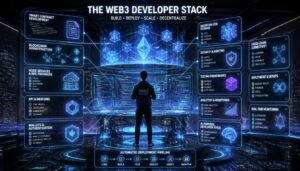
Web3 Development Process 2026: Complete Guide To Building On Blockchain
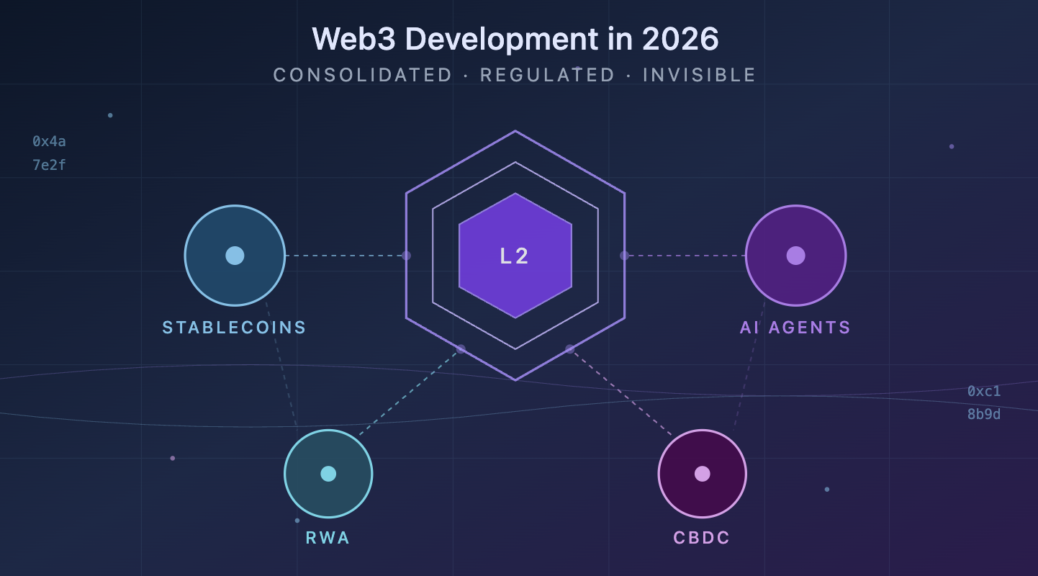
The global blockchain technology market reached $67.3 billion in 2024 (Grand View Research), and the development process has evolved dramatically since. The interesting story isn’t the market size — it’s that “Web3 development” in 2026 looks almost nothing like it did in 2023. The frameworks have consolidated, account abstraction has gone from research project to production default, Layer 2 is no longer a strategic choice but a baseline assumption, and AI has quietly worked its way into nearly every step of the lifecycle.
Here’s how modern Web3 development actually works in 2026, drawing on analysis from TheBlockopedia and other industry sources, with the data points that matter for teams actually shipping today.
Layer 2 Is No Longer Optional — and the Field Has Narrowed Sharply
The single biggest change in deployment strategy: Layer 2 scaling solutions now handle roughly 85% of Ethereum-based application activity. Building directly on Ethereum mainnet without an L2 strategy is almost unheard of in 2026 outside of a narrow band of use cases — high-value settlement, governance contracts, and assets where mainnet credibility itself is the product.
What’s changed since 2024 is that the L2 field is no longer the open frontier it was. The Dencun upgrade in March 2024 dropped data-posting costs to mainnet by roughly 90%, which was supposed to lift all rollups but instead accelerated a brutal winner-take-most dynamic. By early 2026, Base (46.58% of L2 DeFi TVL) and Arbitrum (30.86%) controlled over 77% of the Layer 2 ecosystem’s total value locked, with Optimism adding another ~6% to bring the top three to 83% market dominance. The rest of the field — 50+ rollups that raised at billion-dollar valuations through 2023 and 2024 — is collectively fighting over the remaining sliver. Blockeden
For teams making real deployment decisions, this means the practical menu is shorter than it looks. The active choice is between:
Optimistic rollups — Arbitrum, Base, Optimism. Mature tooling, deepest liquidity, well-understood fraud-proof security model, seven-day withdrawal windows that bridges paper over. Base is the default for consumer apps targeting Coinbase’s funnel; Arbitrum is the default for DeFi protocols needing institutional liquidity; Optimism’s value increasingly lies in the broader Superchain ecosystem it anchors.
ZK-rollups — zkSync Era, Starknet, Scroll, Polygon zkEVM, Linea. Validity proofs rather than fraud proofs, faster finality to L1, no withdrawal challenge period. The historical EVM-compatibility tax is mostly paid down — most ZK-EVMs now run unmodified Solidity. The remaining selection criteria are proving costs at scale, prover decentralization roadmaps, and which ecosystem’s tooling your team already knows.
App-specific L2s and L3s — viable when you have enough native volume to justify the operational overhead and want full control over sequencing, gas tokens, and MEV capture. Almost never the right answer for a project at the idea stage.
The honest framework for picking is no longer “which L2 has the best technology” — they’re mostly converging — but “where do my users, my liquidity, and my integrations already live?” Building on a chain with falling daily active addresses is a strategic bet against the dominant trend.
Account Abstraction Is the New Default
Account abstraction has crossed from experimental to invisible. The most successful implementations are the ones users don’t know they’re using.
The numbers tell the adoption story. EIP-4337 has been widely adopted, with over 26 million smart accounts deployed and more than 170 million UserOperations processed. Some sources put deployment higher, citing over 40 million smart accounts across Ethereum and Layer 2 networks, with nearly 20 million deployed in 2024 alone. The deployment distribution is concentrated where the users are: Base, Polygon, and Optimism lead ERC-4337 adoption, with Base seeing particularly strong growth. Ethereum + 2
The 2026 stack is more interesting than ERC-4337 alone. Ethereum’s Pectra upgrade launched on May 7, 2025, introducing new account abstraction features through EIP-7702. The most significant change allows EOAs to execute code by delegating to smart contracts. Private key owners retain account control while delegated smart contracts can perform actions as if they were the EOA. In practice this means existing wallets — the 100M+ MetaMask and Rabby users out there — can gain smart-account capabilities without migrating to new addresses. By 2026 the stack looks like: EIP-7702 for legacy EOAs, ERC-4337 for fresh smart accounts, ERC-6900/7579 for modular extensions, and cross-chain orchestration layers handling intent routing between them. TurnkeyEco
For developers, this changes the design space concretely:
The features that were experimental in 2024 — social recovery, gasless transactions, session keys, batch operations, passkey signing — are now baseline user expectations, not differentiators. Shipping without them in a consumer app means losing users to apps that have them.
Gas sponsorship has to be a day-one design decision, not an afterthought. Paymaster contracts can sponsor gas on behalf of the user or accept payment in USDC, USDT, or any ERC-20. The economic model for who pays gas — the app, the user, a third party — shapes everything from unit economics to onboarding flow. Stablecoin-first apps where users never hold ETH are now standard. Eco
Session keys have unlocked UX patterns that simply weren’t possible before. Games can grant time-limited, scope-limited keys that execute hundreds of in-game actions without per-transaction signing prompts. Social apps can do the same for likes, follows, and posts. The “every action requires a wallet pop-up” UX is now a marker of dated implementation.
Passkey-based signing — Face ID on iPhone, Windows Hello on laptops, hardware-backed credentials — is shipping in production wallets including Coinbase Smart Wallet and Argent. The seed phrase as primary recovery is on its way out for mainstream users; designing for users who never see one is the right default.
One caveat worth holding onto: smart accounts inherit the security profile of the code they run. The biggest risk is installing an unaudited module; stick to verified registries. The modular account ecosystem (ERC-6900, ERC-7579) is powerful, but every plugin is part of your security surface. Eco
The Tooling Stack Has Consolidated — and Foundry Is Eating Hardhat’s Lunch in Security-Critical Work
The development tooling landscape has matured into a clear two-horse race, but the split is sharper than the topline numbers suggest.
Market share data shows Hardhat powering roughly 60% of new projects, with Foundry around 30% and growing quickly. Truffle accounts for most remaining projects, primarily legacy codebases. But the headline share understates the directional trend. Most DeFi protocols (Uniswap, Aave, Compound) use Foundry for its speed and built-in fuzzing. Most full-stack dApp teams use Hardhat because their web devs are comfortable with TypeScript. Security researchers and auditors overwhelmingly prefer Foundry. Enterprise and corporate projects tend to stick with Hardhat’s plugin ecosystem.
The clean breakdown:
Foundry — Rust-based, Solidity-native testing, built-in fuzzing and invariant testing. Teams adopting Foundry report dramatic improvements in testing iteration speed, with large test suites executing in seconds rather than minutes. The default for protocol engineering, audits, and anything where security is the primary concern. If you’re starting a contract-heavy project from scratch in 2026, this is the right default.
Hardhat 3 — TypeScript-first, broader plugin ecosystem, deeper integration with web tooling. The default when your contracts are tightly coupled to a TypeScript frontend or backend, when your team already lives in Node.js, or when you depend on plugins that haven’t migrated. Best when your contracts are tightly coupled to a TypeScript frontend or backend, when your team already lives in Node.js, or when you depend on plugins that haven’t migrated. DEV Community
The non-obvious thing experienced teams are doing: running both in the same repo. Foundry handles the test suite (forge test against Solidity test files) while Hardhat handles deployment scripting and frontend integration. Many teams write tests in Foundry and deployments in Hardhat — and there’s no real cost to that hybrid setup other than maintaining two configs. Web3 Developer Forum
Beyond the framework war, the wider tooling stack has standardized:
- Contract interaction: viem has effectively replaced ethers.js as the default TypeScript library. Smaller bundle, better tree-shaking, type-safe ABIs end-to-end.
- Wallet connections: wagmi + ConnectKit (or RainbowKit) for React. The component-library debates of 2023 are over.
- Account abstraction SDKs: Pimlico, ZeroDev, Alchemy, Biconomy — pick based on which paymaster/bundler infrastructure you trust and how much you want to self-host.
- Formal verification: Certora Prover and Halmos are now integrated into both Foundry and Hardhat workflows. For protocols holding meaningful TVL, this is moving from “nice to have” to “expected by auditors.”
- AI-assisted development: Claude, Cursor, and Solidity-specific copilots have become standard for writing tests, generating fuzz invariants, and catching common vulnerability patterns. They don’t replace audits, but they materially raise the floor on what a single developer can ship.
Zero-knowledge proof integration has also matured. ZK circuits are now integrated directly into the development workflow rather than bolted on at the end — Noir, Circom, and the toolchains around them have stabilized enough that “add a ZK component” is a sprint, not a project.
The 2026 Development Lifecycle
A typical Web3 project now follows a more structured lifecycle than the move-fast-and-break-protocols pattern of earlier cycles. The shape:
1. Planning and architecture. Choose L1/L2 based on where users and liquidity actually live. Choose storage layer (IPFS for content-addressed assets, Arweave or Storacha for permanent storage, S3 for anything that doesn’t need decentralization theater). Decide the token model — and increasingly, decide whether you need a token at all, since the regulatory environment has made unnecessary tokens an unforced error.
2. Smart contract development. Foundry or Hardhat 3 (or both). AI-assisted code generation for boilerplate and test scaffolding, continuous formal verification on critical invariants. Upgradeability patterns (transparent proxy, UUPS, or diamond) chosen with the upgrade governance model already designed.
3. Security-first design. Threat modeling on day one, not pre-launch. The protocols that survived 2024 and 2025 are the ones that treated security as an architectural concern rather than an audit line item. Q1 2026 alone saw 44 incidents and $482M in losses — the average per-incident loss is climbing because the easy bugs are mostly gone and the remaining exploits are increasingly sophisticated. Hacken
4. Frontend integration. viem for contract interaction, wagmi + ConnectKit for wallet connections, account abstraction SDKs for smart wallet flows, and increasingly, embedded wallet providers (Privy, Dynamic, Turnkey) for apps that want Web2-native onboarding without sending users to MetaMask.
5. Testing. Unit tests (mandatory), integration tests (mandatory), fuzz testing (mandatory for anything with monetary logic), invariant testing (mandatory for DeFi), forked-mainnet tests (mandatory for anything that interacts with existing protocols), testnet deployment with real user flows (mandatory before mainnet).
6. Audit. At least one professional audit, ideally two for protocols with meaningful TVL. AI-assisted vulnerability scanning as a continuous CI check, not a one-time pre-audit pass. Bug bounty live before mainnet, not after.
7. Mainnet deployment. Upgradeable contracts with multisig or DAO governance on the upgrade path. Real-time monitoring (Tenderly, OpenZeppelin Defender, Forta). Emergency response runbook with pre-signed circuit-breaker transactions and a paged on-call rotation. The Wild West era of “deploy and pray” is over for any project handling real value.
Gas Optimization Still Matters (Even on L2)
Gas optimization strategies can reduce transaction costs by 30-70% compared to unoptimized contracts. This sounds like a 2021 concern in an era when L2 fees are measured in cents, but it isn’t — and the reason matters.
L2 fees are cheap per transaction but compound brutally at scale. A protocol doing 10 million transactions per month at $0.02 each is spending $200K monthly on gas. A 50% reduction is a real line item. Then there are use cases — agentic payments, gaming, social apps — where transactions are sub-cent and gas overhead can exceed the value being moved.
The optimization toolkit hasn’t changed dramatically, but the discipline has and is constantly evolving:
- Storage packing — fitting multiple state variables into a single 32-byte slot. Still the single biggest lever for contracts with frequent writes.
- Calldata over memory — for read-only function parameters, calldata is materially cheaper, especially at L2 data-posting prices.
- Efficient data structures — mappings over arrays when you don’t need iteration; bitmaps for boolean flags; packed structs for related data.
- L2-native patterns — calldata pricing, blob behavior, and precompile availability differ across L2s. Code ported from L1 without revisiting these assumptions leaves money on the table.
- Custom errors over revert strings — small saving per revert, meaningful at volume.
- Unchecked math where overflow is provably impossible — modest gains, but free.
The forge gas reporter and Hardhat’s gas reporter plugin should be CI checks, not occasional audits. Regressions in gas usage are easier to catch at PR time than after deployment.
The Bottom Line
Web3 development in 2026 is more structured, more professional, and more accessible than ever. The tools are faster, the standards are clearer, the abstractions are higher-level, and the path from idea to deployed application is dramatically shorter than it was even 18 months ago.
The flip side: the bar is higher too. Users expect Web2-grade UX — passkey login, sponsored gas, no seed phrases visible. Security expectations have caught up with the value being secured; “we shipped fast and got audited later” is no longer a defensible story. The ecosystem rewards teams that understand they’re building on top of a stack of consolidating winners (a few L2s, two real frameworks, a small number of wallet and account abstraction providers) and design accordingly.
The interesting work in Web3 in 2026 isn’t on the protocol layer — that’s largely commoditized. It’s on the application layer, where account abstraction and stablecoin rails have finally made it possible to build products that don’t feel like crypto products. The teams that figure out how to ship those without leaving cost, security, or UX on the table are the ones that will define the next cycle.
Hackathon Tracker