Zero-Knowledge Proofs For Developers: The Ultimate 2026 Guide
Zero-knowledge proofs (ZKPs) are becoming one of the most important technologies in blockchain development. They help developers improve privacy, scalability, and trust without exposing sensitive data.
As blockchain networks grow, scalability and privacy problems become harder to solve. Because of this, ZKPs are now powering modern Layer 2 networks, private transactions, identity systems, and even AI verification.
This guide covers everything developers need to know about zero-knowledge proofs in 2026.
What Are Zero-Knowledge Proofs?
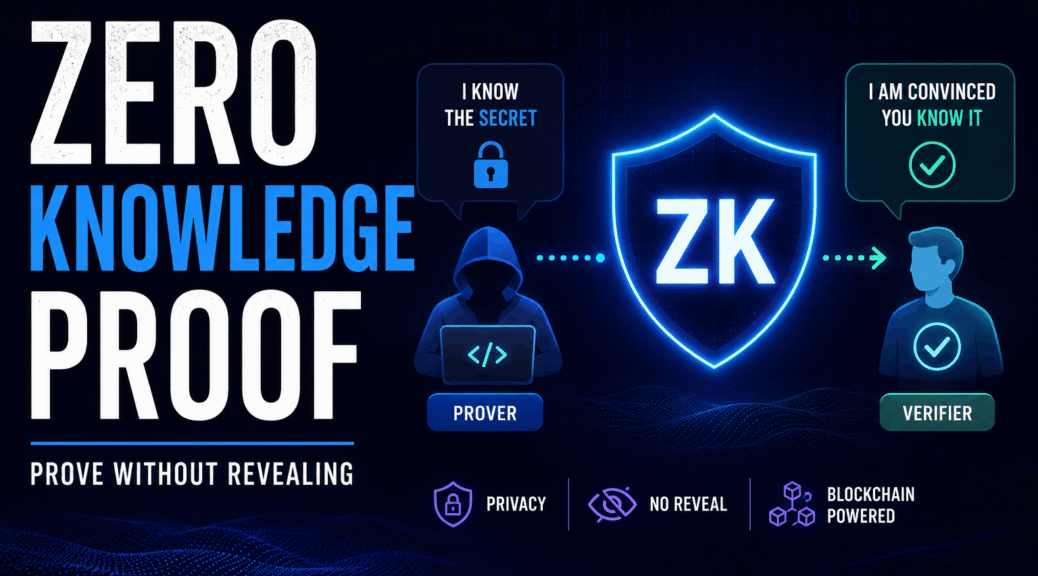
A zero-knowledge proof is a cryptographic method that allows one party (the prover) to prove to another party (the verifier) that a statement is true, without revealing any information beyond the validity of the statement itself.
In simple terms, you can prove something without exposing the secret behind it.
For example, you could prove that you are over 18 years old without revealing your exact birthdate.
Because of this property, ZKPs are extremely useful in blockchain systems where privacy matters.
For a deeper explanation, read “Zk-SNARKs: Under the Hood” by Vitalik Buterin.
Core Properties of Zero-Knowledge Proofs
Every zero-knowledge proof system relies on three important properties.
- Completeness: If the statement is true, an honest prover can convince the verifier successfully.
- Soundness: On the other hand, dishonest users cannot prove false statements.
- Zero-Knowledge: Most importantly, the verifier learns nothing except whether the proof is valid.
As a result, sensitive data always stays private.
Types of ZK Proofs
Several types of ZK systems exist today. However, each one has different tradeoffs.
ZK-SNARKs
ZK-SNARK stands for:
Zero-Knowledge Succinct Non-Interactive Argument of Knowledge
These proofs are small and fast to verify. Therefore, they are widely used in blockchain scaling solutions.
Key Features
- Very small proof sizes
- Fast verification
- Efficient for rollups
- Requires trusted setup
Popular Projects
- Zcash
- Filecoin
- zkSync Era
- Polygon zkEVM
Learn more from the official zkSync documentation.
ZK-STARKs
ZK-STARK stands for:
Zero-Knowledge Scalable Transparent Argument of Knowledge
Unlike SNARKs, STARKs do not require a trusted setup. Additionally, they are considered more resistant to quantum attacks.
However, proof sizes are usually larger.
Key Features
- No trusted setup
- Better scalability
- Quantum-resistant design
- Larger proof sizes
Popular Projects
- Starknet
- Polygon Miden
You can explore more in the official Starknet documentation.
Bulletproofs
Bulletproofs are another type of zero-knowledge proof. They are smaller than many traditional privacy proofs and do not require trusted setups.
Used By
- Monero
- Grin
As a result, Bulletproofs became popular in privacy-focused cryptocurrencies
Real-World Use Cases of ZK Proofs
Zero-knowledge proofs are already being used across Web3 ecosystems.
1. Scalability (ZK-Rollups)
ZK-rollups combine hundreds of transactions into a single proof. Consequently, blockchain networks become much faster and cheaper.
These systems submit compressed proofs to Ethereum Layer 1 instead of posting every transaction individually.
| L2 | Type | TVL | Throughput |
|---|---|---|---|
| zkSync Era | ZK-SNARK | $3B+ | 1000+ TPS |
| Polygon zkEVM | ZK-SNARK | $3B+ | 1000+ TPS |
| Starknet | ZK-STARK | $1B+ | 500K+ TPS |
| Polygon Miden | ZK-STARK | Growing | 1000+ TPS |
2. Privacy
Privacy is another major use case for ZK technology.
Examples
- Zcash enables shielded transactions
- Aztec focuses on private DeFi
- Penumbra enables private trading on Cosmos
You can also explore the Zcash technology overview.
3. Identity & Verification
ZKPs can verify identity without revealing personal information.
For example:
- Prove your age without revealing your birthdate
- Verify credentials privately
- Prevent Sybil attacks in DAOs
Therefore, ZK identity systems are becoming increasingly important in Web3.
4. Cross-Chain Bridges
Cross-chain bridges can also use ZK proofs.
Instead of trusting centralized intermediaries, chains can verify proofs directly. As a result, interoperability becomes more secure.
Popular ZK Development Languages
Several programming languages are now designed specifically for ZK development.
Circom
Circom is one of the most popular languages for designing ZK circuits.
Developers commonly use it for SNARK-based systems.
Official docs: Circom Documentation
// Simple circom circuit template Multiplier() { signal private input a; signal private input b; signal output c; c <== a * b; } component main = Multiplier();Noir
Noir is developed by Aztec. It simplifies writing zero-knowledge applications.
Because of its cleaner syntax, many developers find it easier to learn.
// Simple Noir circuit fn main(x: Field, y: Field) -> Field { x * y } unconstrained fn verify_proof(x: Field, y: Field, proof: Proof) { // Verification logic }Cairo
Cairo powers Starknet and STARK-based applications.
It is designed specifically for provable computation.
// Cairo program from starkware.cairo.common.math import assert_nn func main{output_ptr: felt*}() { tempvar x = 5; tempvar y = 10; // Simple computation assert_nn(x + y); return (); }Getting Started with ZK Development
Learning ZK development can feel difficult initially. However, starting small helps a lot.
Prerequisites
- Basic cryptography knowledge
- Understanding of modular arithmetic
- Rust, Solidity, or JavaScript experience
1. Hardhat-ZKsync
Plugin for zkSync Era development:
// hardhat.config.js module.exports = { zksync: { enabled: true }, networks: { zkSyncTestnet: { url: 'https://testnet.era.zksync.dev', ethNetwork: 'goerli', chainId: 300 } } };2. Foundry-ZKsync
ZK integration with Foundry:
# Install forge install matter-labs/foundry-zksync # Deploy forge create --zksync src/MyContract.sol:MyContract3. Starknet Foundry
Cairo development with Foundry tooling:
# Install curl -L https://foundry-rs.github.io/foundry | bash # Test sncast invoke --contract-address --functionRecommended Learning Path
- Learn ZK fundamentals
- Study SNARKs and STARKs
- Build simple circuits in Circom or Noir
- Deploy projects on testnets
- Explore zkEVM development
Additionally, reading research blogs regularly helps you stay updated.
Resources
| Resource | Description |
|---|---|
| ZKPodcast | Podcasts with ZK researchers |
| Zero-Knowledge FM | Weekly ZK discussions |
| Circom Documentation | Circuit language docs |
| Starknet Docs | Cairo and Starknet |
Career Opportunities
Demand
ZK developers are among the highest-paid in Web3:
| Role | Salary Range |
|---|---|
| ZK Engineer | $150,000 – $400,000+ |
| Cryptographer | $200,000 – $500,000+ |
| ZK Researcher | $250,000 – $600,000+ |
Skills in Demand
- Circuit design (Circom, Noir, Cairo)
- ZK-SNARK/STARK cryptography
- Rust programming
- Solidity + zkEVM
- Mathematical foundations
Major ZK Projects
Layer 2s
- Starknet: STARK-based, Cairo language
- zkSync Era: SNARK-based, EVM compatible
- Polygon zkEVM: EVM equivalent
- Scroll: EVM equivalent ZK-Rollup
Privacy
- Aztec: Private DeFi
- Zcash: Privacy coins
- Penumbra: Private Cosmos DeFi
Infrastructure
- Filecoin: Storage with ZK proofs
- Ironfish: Privacy L1
- Risc Zero: ZK VM
Challenges
Technical Challenges
- Complexity: Steep learning curve
- Trusted Setup: Security ceremonies
- Proving Time: Resource-intensive computation
- Debugging: Hard to debug circuits
Ecosystem Challenges
- Fragmented tooling
- Rapidly evolving standards
- Limited developer documentation
Future of ZK
Major Trends in 2026
- ZK-powered AI verification
- General-purpose ZK virtual machines
- Privacy-focused Layer 2s
- Cross-chain interoperability
- Hardware acceleration for proving
Furthermore, enterprise adoption is beginning to accelerate.
Conclusion
Hackathon Tracker