Web3 Dev Tooling 2026: What Product Hunt’s Latest Launches Tell Us

If you want to know where Web3 development is going, stop reading conference recaps and start watching Product Hunt.
The Web3 category on Product Hunt doesn’t just shine the spotlight on new tools; it also reveals where developer attention, capital, and real user demand are actually focused. And right now, three clear themes dominate the 2026 landscape: cross-chain execution, gas abstraction, and self-custodial automation.
Let’s walk through the launches that define each trend, with actual Product Hunt URLs you can check yourself.
1. Self-Custodial Portfolio Automation — MintLocke
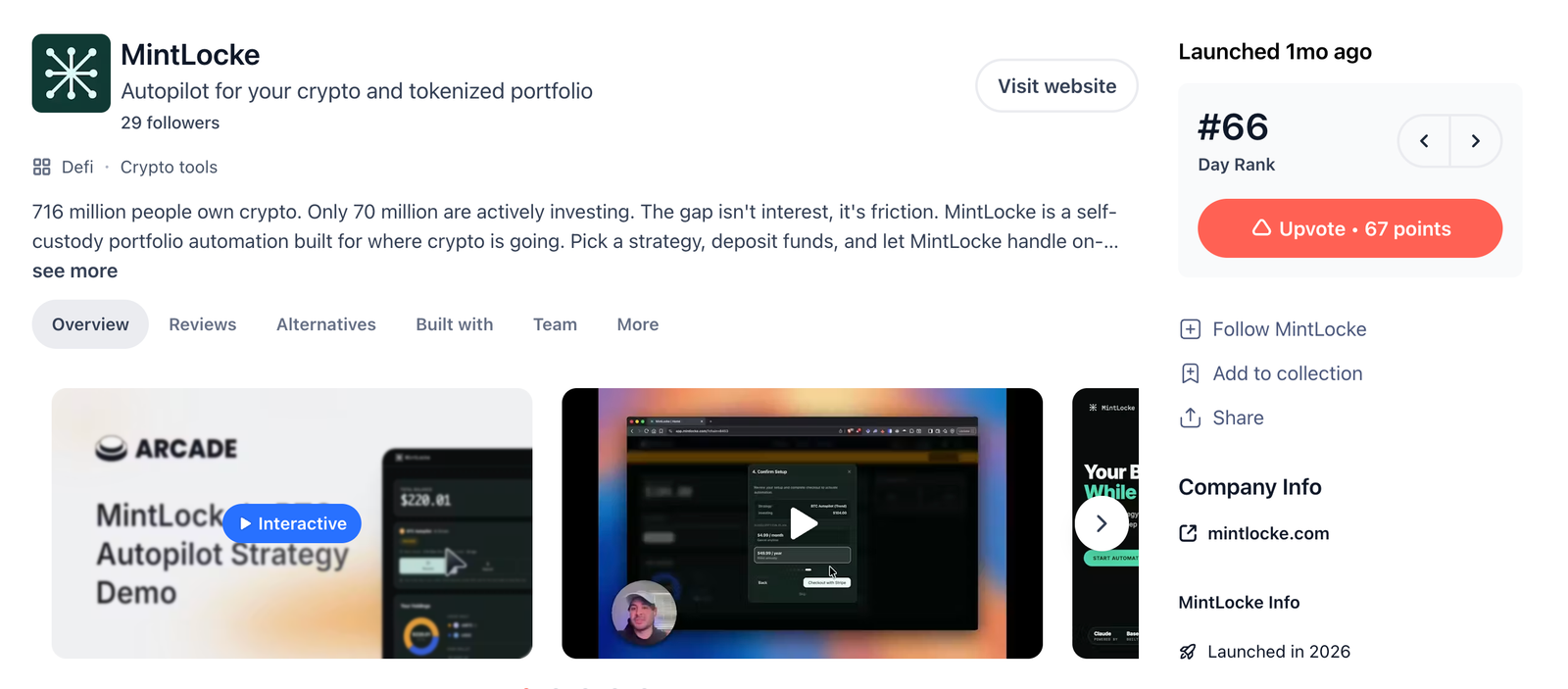
MintLocke describes itself as “autopilot for your crypto and tokenized portfolio.” Pick a strategy, deposit funds, and it handles on-chain execution automatically. No manual decisions, no chart watching, no missed entries. It launched with a Bitcoin Autopilot on Base running a 100/20 EMA crossover on cbBTC, with Claude API-powered execution and tokenized RWAs coming next.
Web3 users increasingly expect set-and-forget tools. If your DeFi protocol or wallet doesn’t offer automated strategy execution, you’re already falling behind user expectations.
Other tools in this space include Clustr for crypto portfolio risk analysis, which helps users assess diversification without hours of manual research.
2. Gas Abstraction — Universal Gas Framework (UGF)
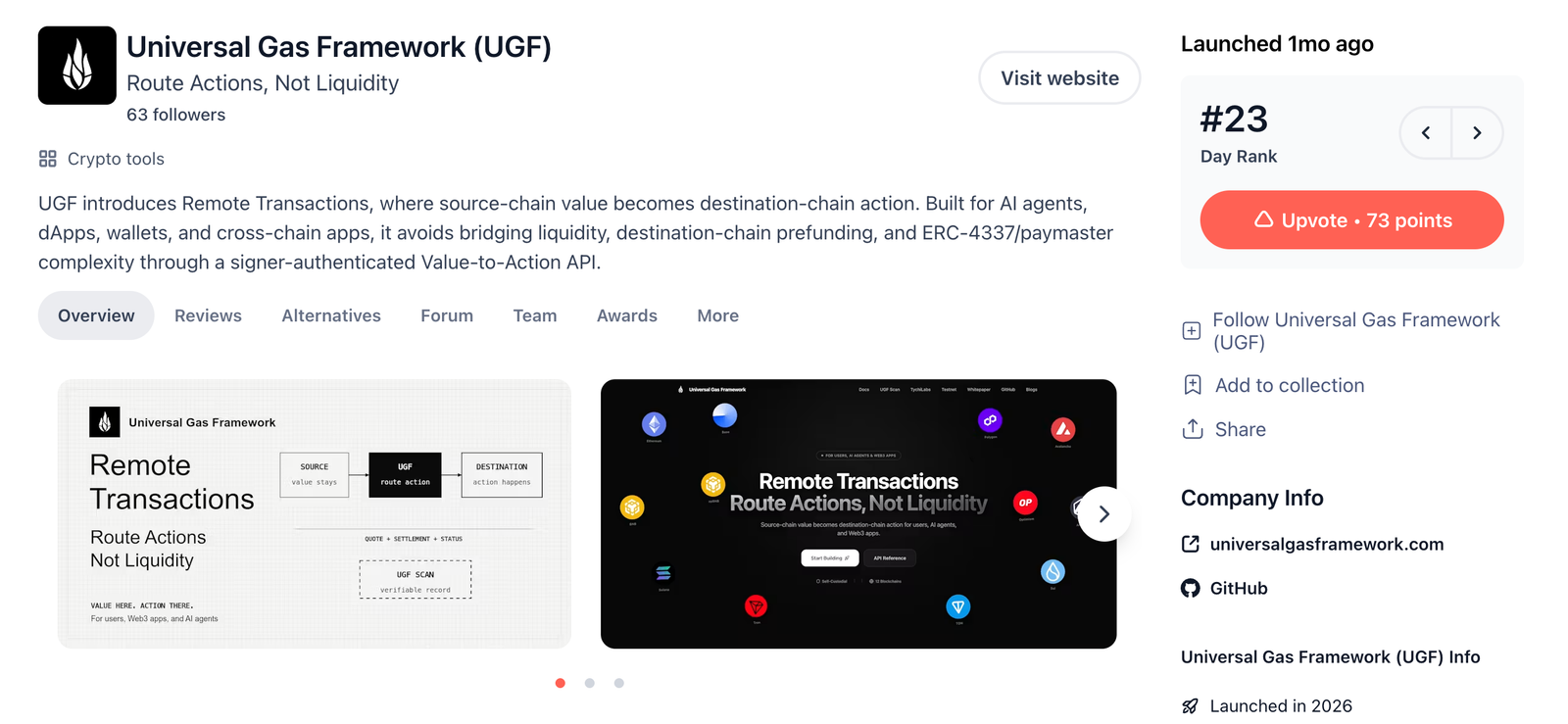
UGF, with the tagline “Route actions, not liquidity,” lets users and AI agents execute transactions across EVM and non-EVM chains without holding native gas tokens. One can pay with stablecoins like USDC or EURC through a unified execution layer.
Every chain has its own gas token, presenting the single biggest UX bottleneck in Web3 today. Users bridging from Arbitrum to Base to Solana need ETH, ETH again, and SOL just to pay fees. UGF solves this by letting source-chain value become destination-chain action — abstracting “gas” entirely from the user’s perspective. For AI agent platforms, this is even more critical.
Chainlink recently covered gas abstraction in depth here, and the trend is directly enabled by the ERC-4337 account abstraction infrastructure that matured throughout 2025.
3. AI-Powered Contract Generation — Noah AI
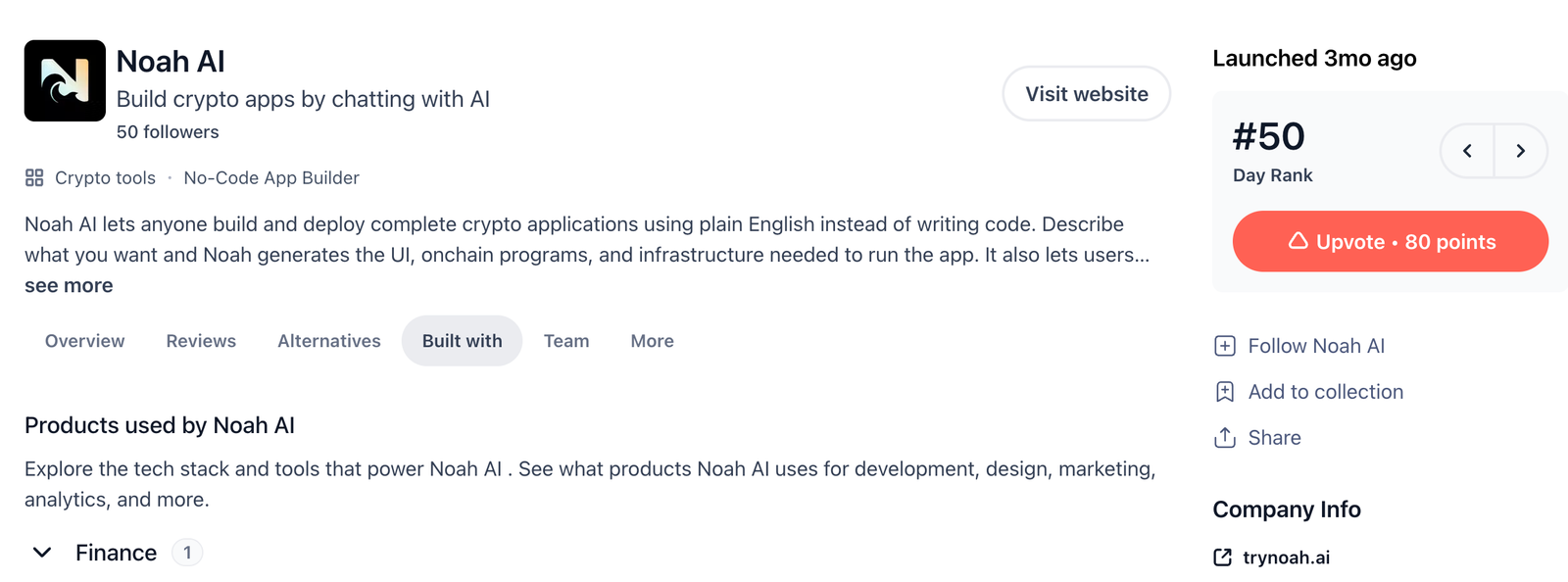
Noah AI lets anyone build and deploy complete crypto applications using plain English. Describe what you want, and Noah generates the UI, onchain programs, and infrastructure. This is a signal that the barrier to Web3 development is dropping fast — natural language to production deployment is already here.
Noah AI’s positioning alongside QuickNode and thirdweb (both dominant in managed infrastructure) shows that the Web3 toolchain is consolidating around an AI-augmented, low-code paradigm.
4. The Infrastructure Backbone — Geth + Chainlink
While new launches grab headlines, the infrastructure layer remains remarkably stable. Geth remains the dominant Ethereum execution client with no serious challenger. Chainlink remains the standard for oracle infrastructure, now expanding into the UX layer with gas-abstraction resources.
QuickNode and thirdweb (both top-rated on Product Hunt’s crypto tools category) round out the managed infrastructure stack — RPC endpoints, data pipelines, smart contract deployment, wallet infrastructure, and payment rails.
Together, these form a “Web3 Backbone” that hasn’t significantly changed in 18 months. New tools build on top of them rather than replacing them.
5. Gas Optimization as a Premium Hiring Skill
With gas limits rising (Glamsterdam’s 200M target) and state growth costs being repriced via EIP-8037, gas optimization has become a distinct hiring specialty. Developers who can demonstrate efficient storage patterns, safe loop design, assembly-level gas golfing, and an understanding of the new state growth pricing are commanding premium salaries.
The 2026 blockchain development roadmap lists gas optimization as a core skill alongside Solidity, L2 knowledge, and security. When gas limits triple and state costs rise, poorly optimized contracts don’t just cost more — they become economically unviable.
Bottom Line
The Product Hunt Web3 category in May 2026 tells a clear story:
- Users want automation — set-and-forget tools that execute strategies without manual intervention
- Gas friction is dying — cross-chain execution without native gas tokens is becoming table stakes
- AI is eating contract development — natural language to deployment is already here
- The backbone is stable — Geth + Chainlink + QuickNode + thirdweb remain unchallenged
- Gas optimization is the new security auditing — a premium skill that pays structural dividends
The tools are already on Product Hunt. The question is whether you’re building with them or against them.
Hackathon Tracker