
How to Build a Verifiable dApp on EigenCloud: A Developer’s Guide to the Full Stack

EigenCloud is more than a rebrand; it is a complete infrastructure stack for developers who need off-chain computation to carry the same trust guarantees as on-chain execution. Built on EigenLayer’s restaking foundation, the platform introduces EigenDA, EigenCompute, and EigenVerify as its core primitives, each solving a distinct layer of the trust problem. This guide walks through how they work together to power a verifiable dApp, from data commitment to dispute resolution.
With Eigen Labs’ offerings reshaping the Web3 landscape, its EigenCloud platform is becoming a key driver of the next generation of use cases. What started off as a restaking protocol, called EigenLayer, massive in its own right due to the transposability of Ethereum’s security resources, has now evolved into EigenCloud, a broader verifiable cloud platform. EigenLayer remains a crucial element of the now bigger stack.
Essentially, EigenCloud is the infrastructure of choice for developers seeking off-chain computation that carries the same trust guarantees as on-chain execution. The platform has expanded beyond offering new yield mechanics, so let us explore its core components, how they interact, and what building a dApp on the stack looks like.
Today, we are looking at a verifiable oracle that fetches off-chain data, processes it through a validation pipeline, and posts attested results to a smart contract.
The Problem EigenCloud is Solving for Builders
Of course, understanding the role EigenCloud plays is necessary before getting into deploying a dApp using the stack.
It makes the most sense to use this platform for use cases that require smart contracts to act on off-chain computations, like in the case of oracles, co-processors, cross-chain bridges and more. In such cases, contracts have no way of knowing that the operator behind the computations behaved correctly, used the right inputs, or ran the right logic.
The traditional decentralized solution would require projects to recruit a validator set, introduce a token to incentivize honest behavior, and bootstrap security for 12 to 18 months to build enough economic security to make attacks expensive. Teams with already tight budgets fail to make this happen, resulting in the product shipping without adequate security. Or even worse, it does not ship at all.
With that being the reality, EigenCloud offers a way to skirt the massive hurdle by tapping into Ethereum’s shared security via restaking. Instead of building bespoke validator networks, developers can launch their AVSs (Autonomous Verifiable Services) that tap into EigenLayer’s existing restaking ecosystem.
This ecosystem currently brings billions of dollars’ worth of cryptoeconomic security straight out of Ethereum, and the operators, who are already staked on Ethereum, restake in the products developers build on the EigenCloud stack. Dishonest behavior is penalized by a slashing mechanism, which has been live on the mainnet since April 2025.
For clarity, EigenLayer is the stack’s primitive, and what Eigen Labs’ leading project was then called. The move to EigenCloud brought more layers into the picture, with EigenLayer becoming the foundation.
The Three-Layer Stack
With EigenCloud’s launch came EigenDA for data availability and an early preview of EigenVerify for dispute resolution. EigenCompute and EigenAI followed a little later on mainnet alpha in September 2025. What is most important to know is that these modules are not loosely coupled; rather, they are designed to be part of an entire ecosystem and work in synergy.
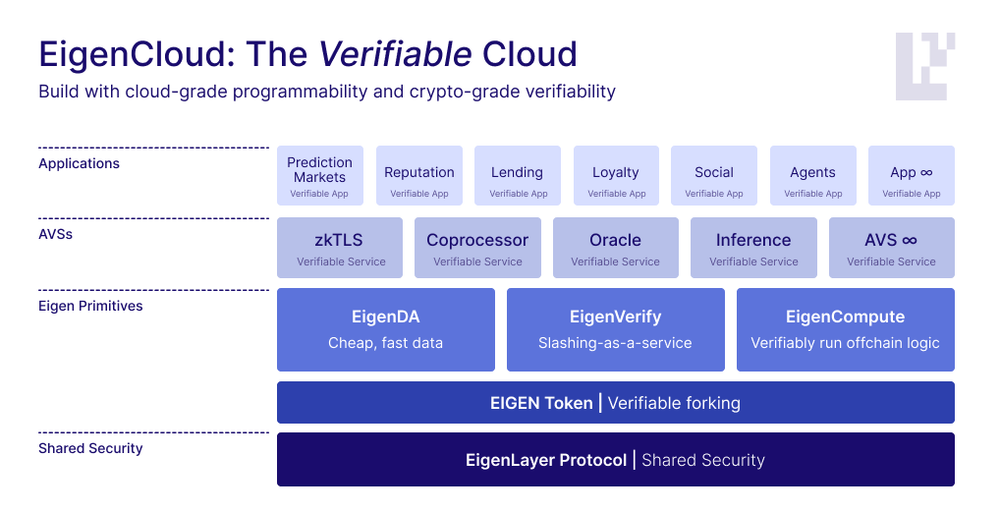
All requests flow from the application layer into EigenDA, through EigenCompute, and are settled via EigenVerify. Looking at each layer makes understanding the integration pattern clearer.
EigenDA: Committing to Your Inputs
EigenDA is the first layer in terms of data flowing into a dApp from off-chain sources. For our oracle example, this would imply that raw price feed snapshots (multiple sources, raw values, and timestamps) get committed to EigenDA before the validation pipeline touches them.
The concern here is that there is no way to prove what inputs a computation ran on without a committed data record. An operator is free to claim they processed one dataset while they actually did so for another. EigenDA solves this by creating a cryptographic commitment to the posted data blob. Downstream computation processes attest to the same commitment, with this layer being the anchor point for any dispute process.
Furthermore, EigenDA was the first production AVS Eigen Labs brought to the table, which obviously happened under the EigenLayer banner. It has now been running at scale for long enough that its performance characteristics are well understood. For developers working on rollups, it functions as a high-throughput data availability layer, on par with other popular ones like Avail and Celestia, but backed by Ethereum restaking instead of a separate validator set. For those working on oracles and co-processors, it is the input integrity layer that makes everything downstream verifiable.
The commitment returned from EigenDA is what chains the entire request together. If results are challenged later, the dispute process starts by verifying that commitment against what was actually posted, with every subsequent step in the pipeline referencing it.
EigenCompute and EigenAI: Off-Chain Execution with On-Chain Accountability
The next layer in the stack is EigenCompute, and as the name states, it is where the computations run. For the oracle dApp, the validation logic includes checking price sources against each other, detecting any outliers, and computing the canonical value to post on-chain.
Eventhough EigenCompute runs entirely off-chain, its operation is completely different from running the same logic on a standard cloud server, as the operation’s execution is constrained and verified by smart contracts. The environment attests that a specific computaton ran against a specific input, EigenDA commitment from the previous step to produce a specific output.
The EigenCompute layer is designed to support flexible off-chain workloads without requiring developers to adopt a new virtual machine — the verifiability machine wraps around the existing logic brought by builders. The DevKit tooling handles the scaffolding for registering a computation module as an AVS, defining task inputs and outputs, and wiring the attestation flow to the settlement contract.
EigenAI launched alongside EigenCompute in September 2025 and applies this same framework specifically to model inference. If the oracle’s validation logic uses an ML model to detect anomalous prices, EigenAI produces cryptographic evidence that a certain model, which runs on certain inputs, creates a certain output. Instead of asking users to trust that the model ran correctly, the dApp provides cryptographic proof that it did.
dApps operating at the intersection of blockchain and AI technologies now have an accountability layer that centralized inference providers cannot offer.
EigenVerify: Dispute Resolution and Slashing Enforcement
EigenVerify is the last layer and closes the loop via an optimistic mechanism. Essentially, the results submitted on the settlement contract are accepted by default during a challenge window — any party believing the computation was incorrect can raise a dispute within the window through EigenVerify.
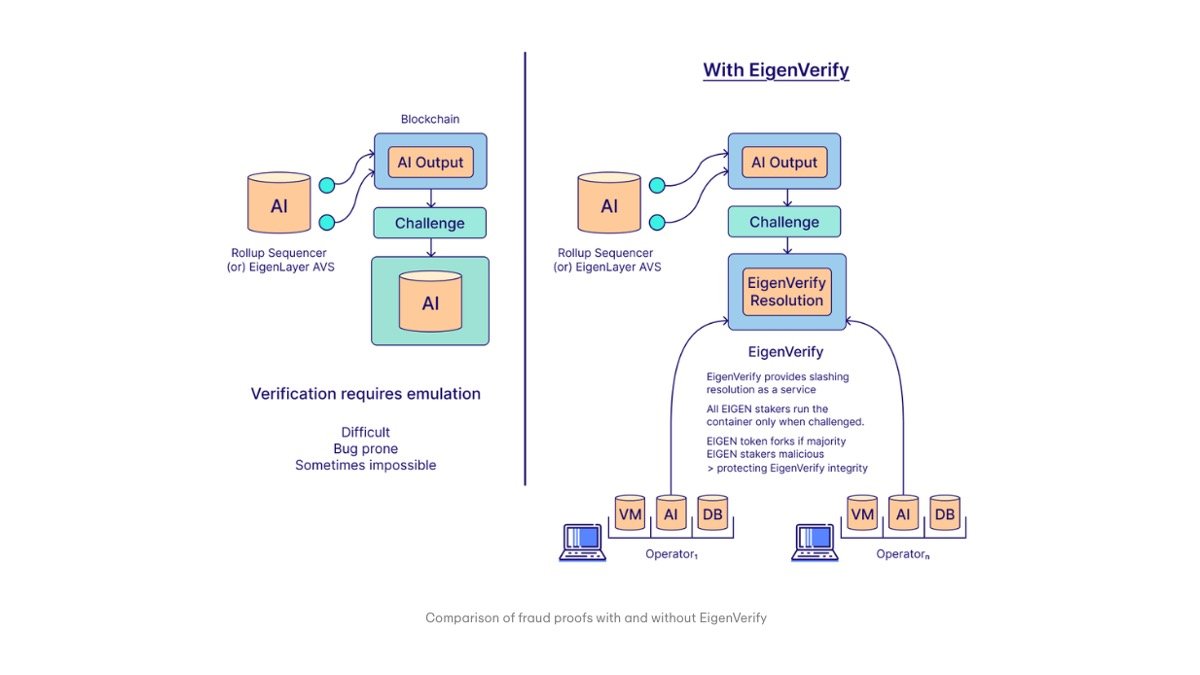
The dispute process resolves by verifying the attestation chain for the following parameters. Was the input commitment valid? Did the computation run against that commitment? And does the output match the attestation? EigenVerify plays the role of adjudicating disputes and serves as the basis of enforcing slashing conditions on restaked ETH when the attestation chain breaks down.
EigenVerify thus acts as the cryptoeconomic enforcement layer that makes the entire system credible. Operators take their actions knowing that dishonest behavior bears direct financial costs. The practical implication is significant for builders as the settlement contract does not have to re-execute off-chain logic on-chain, doing away with the tremendous costs associated with re-executing complex computations. For ML inferences, this would otherwise be impossible.
The cryptoeconomic security associated with this optimistic model acts as the basis for advancing contract-level trust without contract-level execution costs.
AVS Architecture: Choosing the Right Archetype
Knowing the flow of the stack is only one aspect of deploying an AVS. Developers must also understand the archetypes introduced by EigenCloud to successfully get a product running. And those come in two distinct flavors: task-based and epoch-based.
Task-based AVSs are built for discrete, request-response workloads. For an oracle, each price update is a task comprising a defined input, computation step, and settlement event. EigenCloud’s task lifecycle manager, Hourglass, handles task registration, operator assignment, and settlement sequencing. The platform’s DevKit tooling has mature support for this pattern, and is the right default for oracle, co-processor, and bridge use cases.
Epoch-based AVSs are created for continuous services that need to validate states at regular intervals, and work best for sequencers, keeper networks, and rollup services, with operators working within defined epochs and being evaluated at epoch boundaries. The economic model varies slightly here as rewards and slashing conditions are assessed at the end of an epoch instead of tasks.
Developers must understand that these archetypes are architectural — not just cosmetic — and can affect how operators are rewarded, disputes are scoped, and how dApps can handle partial failures. Teams that are just starting out can opt for the task-based archetype unless their workload is fundamentally continuous.
Multi-Chain Deployment with Multichain Tooling
EigenCloud’s architecture has focused on making deployment and operation as convenient as possible for developers seeking on-chain trust, and its multi-chain feature is pushing that even further. With it, AVSs are not confined to Ethereum, but can operate across layer 2 networks and independent chains. Attestations and slashing conditions are bridged cross-chain.
For an oracle, this is massive, since most DeFi dApps are launched on networks like Base, Arbitrum, and specific appchains, among numerous others.
The Multichain tooling specifically handles the bridging mechanics — developers decide which chain the AVS operates on, and the slashing conditions follow. There is no need to build security for every chain; EigenCloud essentially allows the extension of the same restaked security pool across. For modular blockchain setups, this is of high significance, as rollups needing data availability and cross-chain messaging layers can tap into this practical solution.
The Full Request Lifecycle
When connecting all the dots across EigenCloud’s offerings, here is what a single oracle update looks like end-to-end.
A keeper or scheduled call initiates a new price update task on the AVS registry, leading operators to fetch price data from the defined sources, which is posted to EigenDA to generate a cryptographic commitment that gets anchored on-chain. The validation and aggregation logic runs inside EigenCompute against the committed dataset; EigenAI generates an inference attestation if an ML model is involved. The operator submits the computed price and the full attestation chain to the settlement contract. EigenVerify opens the challenge window, at which point watchers or competing operators can dispute if the attestation is invalid. If unchallenged within the window, the price is accepted. If challenged, EigenVerify adjudicates and enforces slashing conditions on dishonest operators.
Where the Stack Is Today
At the EigenCloud launch, dozens of AVSs were already live on mainnet with flagship integrations including LayerZero and Infura, and EigenCompute and EigenAI joined later to complete the full three-layer stack. Multichain was introduced to extend the security model to layer 2s.
For developers building oracle networks, co-processors, verifiable AI services, or cross-chain messaging layers, EigenCloud is emerging as one of the most ambitious production environments for verifiable off-chain services. The security bootstrapping problem that killed or indefinitely delayed dozens of similar projects is largely solved by the restaking layer. The tooling surface is mature enough to build on without inventing infrastructure along the way.
The question for any team is whether their off-chain computation problem is the right shape for EigenCloud’s trust model.
Hackathon Tracker