
The 2026 Crypto Shakeout: What 100+ Dead Projects Leave Behind
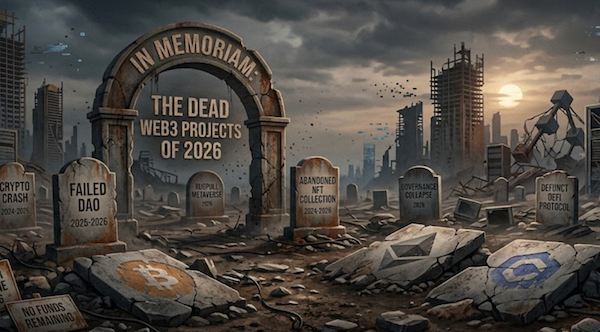
2026 hasn’t been so good for web3, with hundreds of projects calling it quits. The data from RootData’s 2026 Crypto Dead Projects List more than 100 crypto projects that have shut down this year, filed for bankruptcy, or gone permanently dark in 2026 — and the pace is accelerating. We don’t mean rug-pull scams either, these projects were comparitively successful and promising when they began.
Four major firms announced closures within a single week in late July alone: BitMEX, BitMart, Movement Labs, and Storj Labs. Whats surprising is that these dead projects did not have a single domino that caused this unlike in 2022. There is no Terra, no FTX, no single point of contagion. Instead, the industry is living through what Ark Invest’s director of research Lorenzo Valente calls “the biggest consolidation phase in crypto’s history.“ It is a 1998 dot-com-style shakeout — and just like the dot-com shakeout.
True Numbers Behind the Cull
RootData’s tracker had counted 99 closures by late July; by early August, independent trackers put the figure closer to 110, with CryptoSlate’s own tracker identifying 109 shutdowns, wind-downs, or inactive projects as of August 5. The year is not done yet, with editors at CryptoSlate predicting another 52 smaller projects with little to no revenue could push the real total toward 161. Whats more surprising is that every layer of the industry is represented: exchanges, wallets, DeFi lending protocols, NFT marketplaces, derivatives platforms, and even entire layer-1 chains.
| Sector | Projects shut down (2026 YTD) |
|---|---|
| DeFi protocols | 28 |
| Derivatives protocols | 15 |
| Gaming | 15 |
| Infrastructure | 13 |
| Layer-1 / Layer-2 chains | 12 |
| NFTs | 10 |
| Wallets, exchanges & analytics | 18 |
The monthly death count tells the same story: 27 recorded closures in April, 21 in May, 20 in June, 14 in July. DeFi has absorbed the largest share of losses — more than half of all closures, per RootData — while the 15 dead derivatives protocols make that sector proportionally the hardest hit.
The Memorable Ones
While not all of them were giants, some of the dead ones were foundational. BitMEX — the OG exchange that invented the perpetual swap and made Arthur Hayes a legend — announced on July 23 that it will cease operations on September 23. BitMart followed three days later with an orderly wind-down. Their exits erase two of the most recognizable brands in centralized crypto trading.
Saddest of them was POAP, the Proof of Attendance Protocol that turned “I was there” into a verifiable on-chain credential and a collectible. After more than five years and 7.6 million badges minted — adopted by Coinbase and even American Express — co-founder Isabel Gonzalez announced on August 3 that the project is winding down. POAP had already slipped into maintenance mode on March 16, unable to fund its open-protocol ethos with crypto’s brutal funding cycles. The badges remain on-chain; the company behind them does not.
The list of the fallen gods reads like a tour of the 2021-2024 bull market’s greatest hits:
- Zapper — the beloved DeFi dashboard, closed August 3 after founder Sébastien Audet announced its shutdown in July.
- Tally — DAO governance tooling that powered voting for 500+ protocols including Uniswap, Arbitrum and ENS, processed over $1 billion in payments and secured up to $80 billion in on-chain value. “There isn’t a venture-backed business in governance tooling for decentralized protocols, at least not yet,” co-founder Dennison Bertram wrote.
- Step Finance — a Solana portfolio tracker felled in February after a phishing attack drained 261,854 SOL (~$35 million) from its multisig; rescue capital never arrived.
- Everclear — a cross-chain settlement protocol that hit $500 million in monthly volume and still ran out of money before its enterprise partners went live.
- Polynomial Protocol — a derivatives platform that processed $4 billion in peak volume, closed as liquidity dried up.
- Moonbeam — an entire Polkadot parachain that stopped producing blocks on July 31, stranding users who hadn’t bridged assets off in time, including positions in the lending protocol Moonwell.
- Loopring, Goldfinch, NFTfi, UX, Botanix, Parsec, Leap Wallet — an L2, a credit protocol, an NFT lending marketplace, a lending chain, a Bitcoin L2, an analytics firm and a popular wallet, all added to the dead list by mid-year.
Even Polygon’s zkEVM — once the flagship of the Polygon ecosystem called it quits last month, a deprecation that had been planned since June 2025. Nothing was too big, too loved, or too well-funded to survive and most of the team and its foundational ideas had moved on to other projects such as the Billions Identity network, which itself looks close to death.
The Unsustainable Token-As-Revenue Model Broke
Strip away the sector labels and the obituaries and one thing stands out in most dead projects. These dead crypto projects never generated revenue in the traditional sense. Development and marketing was handled in their own tokens or the stable coin these projects traded in early with their own tokens, subsidized liquidity in own tokens, listed on exchanges with own tokens and even funded audits in tokens. As long as those tokens held their dollar value, the machine worked until it didn’t.
The bear market showed how unsustainable these projects were really were. The vast majority of altcoins lost 70% to 90% of their value, and treasury runway calculations — denominated in collapsing tokens — became fiction overnight. Everclear’s post-mortem is the template, that despite reaching $500M in monthly volume, the cross-chain solvers segment never developed the commercial depth that the project needed, their runway ran out before their partners did.”
That is usage without revenue — the defining failure mode of this cycle. A protocol can be used by thousands of people and still be a business that doesn’t exist. As we noted in our analysis of why TVL is a misleading metric, headline numbers have never been a proxy for sustainable cash flow.
AI Enabled Hacks Becoming Widespread
This year was also the year which saw the worst stretch of DeFi exploits on record. A Blockaid report estimates $1.1 billion was lost to on-chain exploits in H1 2026 — more than all of 2025 combined. April 2026 became the most-hacked month in crypto history by number of incidents, headlined by a $293 million exploit of Kelp DAO and a $285 million theft from Drift Protocol, where North Korean-affiliated hackers spent six months socially engineering their way in without touching a line of smart contract code. This year was also we found out about the Z-cash bug that allowed unlimited amount of tokens being printed, but thanks to its privacy protecting nature, we aren’t going to know how much exactly was printed or where it went.
TRM Labs estimates that North Korean-linked actors now account for 66% of all crypto hack losses — up from under 10% earlier this decade. Thanks to AI enabled code debugging and penetration testing, the sophistication of these operations has raised the floor cost of security beyond what mid-tier protocols can sustain.
The difference this cycle is what happens after a hack is iver. In 2021, a community would rally, a treasury would cover the shortfall, and the protocol would relaunch stronger. In 2026, token-denominated treasuries have already depleted by the bear market, and VCs are not writing rescue checks. Step Finance is the cautionary tale: one phishing attack, no rescue, dead in weeks.
The Zombie Problem
Not every dead protocol disappears cleanly. When teams dissolve, the smart contracts they deployed keep running — and the code never dies. In July, a $6 million exploit at Lazy Summer Protocol was traced directly to Stream Finance, a protocol that collapsed in November 2025. Eight months after going dark, Stream Finance’s unresolved code became the attack vector for a live protocol.
Moonbeam’s shutdown adds a more visible dimension: its contracts are still there, but nobody is left who can do anything about them. Security researchers warn that orphaned contracts often carry unpatched vulnerabilities that were deprioritized before a team’s shutdown — and the audit reports users rely on were written for specific versions of code that no longer reflect what’s running. As the graveyard grows, so does the attack surface of abandoned, live-but-headless contracts.
A mechanism needs to be put in place to check for contracts from dead projects and made inactive so as to not cause issues in the future. So far none of the major chains have implemented plans for such a scenario.
Shakeout Leaves the Strong Ones Standing
The survivors share a trait that has nothing to do with marketing budgets or token pricing: A strong financial business plan and a strong development community. Aave, Hyperliquid and Ether.fi — the names industry leaders keep pointing to — are businesses+developers first and tokens second.
The market has stopped rewarding narrative and started rewarding cash flow — violently. Consolidation is happening across all of crypto right now, not just l2’s, a sign of a maturing industry. The networks continuing through this period are the ones people actually use and depend on.
Meanwhile, the institutional side of the industry is quietly scaling on governed rails: Visa’s stablecoin settlement pilot reached a $7 billion annualized run rate across nine blockchains, JPMorgan’s Kinexys has processed over $3 trillion since inception, and Swift is preparing tokenized cross-border payments with 17 banks. The cypherpunk dream isn’t dead — but the version of it that survives may look a lot more like Wall Street with programmability than like an ungoverned parallel economy. The shakeout is already visible in the developer job market too, with web3 job postings down 70% since 2021.
Projects with a skilled developer base have shown to be more resistant to overall survival of any project. Cohort’s CEO, Gautham belives that “developers are the best advocates of a platform, could be a L1 or L2, it’s the developers who recommend their preferred chains to their teams, this ensures a project will be adopted where ever the developers go.”
When Will This End
For every crypto project that we hear about shutting down, there are possibilty another 10 silently doing the same, with no one remaining on the team to . Creative destruction for the next cycle perhaps, with currently no end in sight.
The dot-com comparison is instructive. Pets.com and Webvan died; Amazon and eBay built the infrastructure the entire internet runs on today. The 2026 shakeout is doing the same filtering for crypto: protocols with real cash flow are separating from narrative-only projects, and the survivors are the ones that meet users where they already are — with a product that charges for value delivered.
For builders, the lesson is brutally simple. Ensure a strong financial plan: Charge fees, keep a treasury that survives a 90% drawdown in your own token. Build something people pay for, not something people speculate on. Built a strong builder base and a community, that not just interested in investing. The 100+ projects in the 2026 graveyard — from the exchange that invented perps to the protocol that minted 7.6 million memories — all learned that lesson too late.
Blockcritics is an independent publication covering blockchain technology, market structure, and the developers building both. Follow our coverage of DeFi and blockchain infrastructure for the stories the market tells you to ignore.
Hackathon Tracker