AI Agents On Blockchain: The Complete Developer Guide 2026
AI agents on blockchain are creating a new category of autonomous Web3 applications. These intelligent systems can own wallets, execute smart contracts, manage digital assets, and interact with decentralized protocols without constant human input.
As artificial intelligence and blockchain technology continue to evolve, developers are beginning to build autonomous agents capable of trading, governance, portfolio management, and machine-to-machine interactions.
This guide explores how AI agents on blockchain work, their architecture, real-world use cases, and how developers can start building them in 2026.
What Are AI Agents on Blockchain?
AI agents are autonomous software systems that can make decisions and perform actions independently.
When connected to blockchain networks, these agents gain the ability to:
- Make decisions based on data and AI models
- Own blockchain wallets and assets
- Execute smart contract functions autonomously
- Interact with other agents and humans
- Learn and adapt to conditions
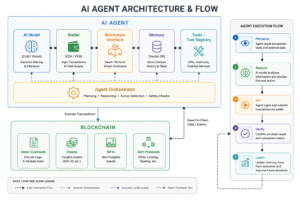
Key Components
| Component | Function |
|---|---|
| AI Model | Decision making, inference |
| Wallet | Sign transactions, hold assets |
| Blockchain Interface | Read/write to smart contracts |
| Memory | Store context, history |
| Tool Registry | Available actions, APIs |
Together, these components allow agents to operate autonomously.
How AI Agents Work
Architecture
How AI Agents Work
Most AI agents follow a simple execution cycle.
1. Perceive
First, the agent reads blockchain data, market prices, wallet balances, or external APIs.
2. Reason
Next, the AI model analyzes the data and decides what action to take.
For example, it may:
- Buy or sell tokens
- Rebalance a portfolio
- Vote in a DAO
- Execute a smart contract call
3. Act
The agent then signs and submits blockchain transactions using its wallet.
4. Verify
After execution, the agent confirms whether the transaction succeeded.
5. Learn
Finally, the system updates memory and improves future decisions.
As a result, agents become more adaptive over time.
Why AI Agents Matter in Web3
Traditional automation relies heavily on centralized infrastructure. However, blockchain enables AI agents to operate in trustless environments.
This creates several new possibilities:
- Autonomous financial systems
- AI-managed organizations
- Self-operating marketplaces
- Machine-to-machine payments
- Decentralized AI economies
Consequently, many developers believe AI agents could become one of the biggest trends in Web3.
Real-World Use Cases of AI Agents
AI agents are already being tested across DeFi, gaming, governance, and infrastructure.
1. Autonomous DeFi
Decentralized finance is one of the largest opportunities for AI agents.
AI Trading Agents
Agents can:
- Analyze market conditions
- Execute trades automatically
- Monitor gas fees
- React to volatility
- Manage risk dynamically
Because markets operate 24/7, autonomous agents are especially useful in crypto trading.
Yield Optimization
AI agents can also move funds between protocols to maximize yield.
For example, an agent may:
- Compare APYs across protocols
- Bridge funds across Layer 2s
- Exit risky protocols automatically
- Optimize staking strategies
As a result, users can automate complex DeFi strategies.
2. AutonomousGovernance
AI agents can participate directly in DAO governance.
Examples
- Automated treasury management
- Proposal analysis
- Governance voting
- Risk assessment
- On-chain execution
Therefore, DAOs may eventually rely on AI agents for operational decisions.
3. NFT & Gaming
Gaming is another major area for autonomous agents.
Popular Use Cases
- AI-powered NPCs
- Autonomous NFT traders
- Dynamic NFT metadata
- On-chain game economies
Additionally, AI agents can create more realistic in-game interactions.
4. Infrastructure
AI agents can also manage blockchain infrastructure itself.
Examples
- Dynamic pricing oracles
- Self-balancing liquidity pools
- Automated market makers
- Smart routing systems
Because of this, protocols can become more efficient and responsive.
Popular AI Agent Platforms
Several projects are building infrastructure for autonomous AI agents.
1. Autonolas
Autonolas focuses on decentralized autonomous services.
Features
- AI service orchestration
- Tokenized agents
- Multi-agent coordination
Official website: Autonolas
2. Fetch.ai
Fetch.ai builds autonomous economic agents for machine-to-machine interactions.
Features
- AI marketplace
- Agent-based automation
- Machine learning integration
Official website: Fetch.ai
3. Ocean Protocol
Ocean Protocol focuses on decentralized AI data marketplaces.
Features
- Privacy-preserving data sharing
- Data tokenization
- AI training infrastructure
Official website: Ocean Protocol
4. SingularityNET
SingularityNET is building a decentralized AI marketplace.
Features
- AI service registry
- Open AI ecosystem
- Long-term AGI vision
Official website: SingularityNET
5. Rising
- AI agent token
- Agent-to-agent commerce
Building AI Agents on Blockchain
Developers usually combine AI frameworks with blockchain SDKs.
Tech Stack
- Gnosis Safe, Lit Protocol
| Layer | Tools |
|---|---|
| AI Models | OpenAI, Anthropic, local models |
| Agent Framework | LangChain, AutoGPT, CrewAI |
| Blockchain | ethers.js, viem, web3.js |
| Wallets | Privy, CDP |
| Storage | IPFS, Ceramic |
If you are exploring AI infrastructure, check out:
Basic Agent Structure
// Simple AI Agent Pseudocode class BlockchainAgent { constructor(wallet, aiModel) { this.wallet = wallet; this.ai = aiModel; this.memory = []; } async perceive() { // Read blockchain state const prices = await this.getPrices(); const balances = await this.getBalances(); return { prices, balances }; } async reason(state) { // AI decides action const prompt = `Current state: ${JSON.stringify(state)} What action should I take?`; return await this.ai.complete(prompt); } async act(decision) { // Execute transaction const tx = await this.wallet.sendTransaction({ to: decision.target, data: decision.calldata }); return tx; } async loop() { while (true) { const state = await this.perceive(); const decision = await this.reason(state); if (decision.action) { await this.act(decision); } await this.sleep(60); // Check every minute } } }Example: AI Trading Agent
const { ethers } = require('ethers'); const { LangChain } = require('langchain'); const { OpenAI } = require('langchain/llms/openai'); class TradingAgent { constructor(privateKey, rpcUrl) { this.wallet = new ethers.Wallet(privateKey, new ethers.providers.JsonRpcProvider(rpcUrl)); this.llm = new OpenAI({ temperature: 0.7 }); } async analyzeMarket() { const prompt = `Analyze current DeFi market conditions. Consider: - ETH price trend - Gas fees - TVL changes - Recent exploits Provide a trading recommendation.`; return await this.llm.call(prompt); } async executeTrade(token, amount, type) { const abi = ['function swap(uint amountIn, uint amountOutMin)']; const contract = new ethers.Contract( routerAddress, abi, this.wallet); const tx = await contract.swap(amount, 0, { gasLimit: 200000 }); return tx.wait(); } }Smart Contract Integration
Agent-Friendly Contracts
// SPDX-License-Identifier: MIT pragma solidity ^0.8.19; contract AutonomousTrader { address public agent; mapping(address => uint256) public allowances; modifier onlyAgent() { require(msg.sender == agent, "Not authorized"); _; } function setAgent(address _agent) external { agent = _agent; } function trade( address tokenIn, address tokenOut, uint256 amount, bytes calldata data ) external onlyAgent { // Trading logic } function rebalance() external onlyAgent { // Portfolio rebalancing logic } }Security Considerations
Risks
- Smart Contract Vulnerabilities: AI can execute buggy code
- Oracle Manipulation: AI can be fed false data
- Wallet Security: Private key exposure
- Unintended Actions: AI makes mistakes
Mitigations
- Multi-sig: Require human approval for large transactions
- Limits: Set transaction size caps
- Monitoring: Alert systems for unusual activity
- Kill Switch: Emergency stop functionality
- Oracle Verification: Use multiple data sources
Emerging Projects
Agent Platforms
- AI agents onchain
| Project | Type | Focus |
|---|---|---|
| Virtuals Protocol | Agent Launchpad | AI agent creation |
| ai16z | Agent DAO | Decentralized AI |
| Virtual Protocol | Agent Token | |
| Sentient | Platform | Open agent platform |
Notable AI Agents
- Truth Terminal: AI that tweets and holds $GOAT
- Luna: Autonomous trading agent
- Agent DAO: AI-managed decentralized organization
Future Trends
2026 Predictions
- Agent-to-Agent Commerce: Agents trading with each other
- True Autonomous DeFi: Self-managing protocols
- AI-Native Chains: Blockchains designed for AI
- Verification: Proving AI decisions on-chain
Long-term Vision
- Fully autonomous economic agents
- Decentralized AI networks
- AI-owned infrastructure
Getting Started
Quick Start
# 1. Set up wallet const wallet = ethers.Wallet.createRandom(); # 2. Fund with testnet ETH # 3. Connect AI model const model = new OpenAI({ apiKey: process.env.OPENAI_KEY }); # 4. Build agent logic const agent = new TradingAgent(wallet.privateKey, RPC_URL); # 5. Run agent agent.start();Learning Resources
- LangChain Documentation
- OpenAI API Docs
- Ethers.js Documentation
- DeFi Primitive Patterns
Conclusion
AI agents on blockchain represent a fundamental shift in how we think about autonomous systems. The combination of AI decision-making with blockchain’s trustless execution creates possibilities that didn’t exist before.
Key takeaways:
- AI agents can autonomously manage funds and execute trades
- Security is paramount—start with small amounts
- The space is rapidly evolving with new platforms
- Multi-sig and limits help mitigate risks
We’re still early in this space. Developers who understand both AI and blockchain will be positioned to build the autonomous financial systems of the future.
Hackathon Tracker